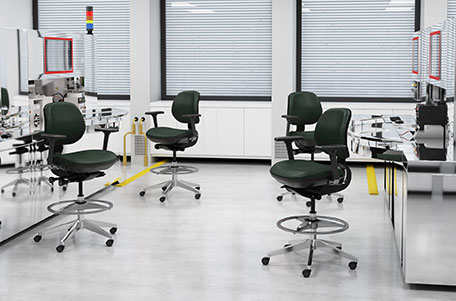
Decision-makers know there are many particulars stipulated within the ISO-14644-1 standard which may not directly apply but ultimately determine any ergonomic chair considered for use in cleanrooms.
Largely those specifications define air cleanliness based on airborne particle concentration and the impact of the product in the chosen environment in support of that target. Eligible seating options to accommodate those environments and the tasks conducted within them must be made of materials that do not shed particles, fibers or dust—and in many cases—assembled, wiped down, and packaged with great attention to detail before delivery.
Far from a matter best left to anyone looking to sell an inferior product.
Especially because the pertinent factors go beyond just dollars and cents. Poorly chosen seating can generate particles and disrupt optimal airflow, leading to potential contamination and failure to meet certification requirements. For instance, in our arena, chairs designed to meet standards toward the upper end of the scale, including ISO 3 and ISO 4, feature under-seat, airflow-exchange systems that prevent the discharge of air into the surrounding environment.
For one thing, that’s important for compliance at higher ISO classes; but also, for what it means for manufacturing in keeping pace with today’s rapidly evolving scientific and technical landscape.
Just as tools and techniques change over time, so must the chairs people use in order to continue working safely and productively in cleanrooms of most every description. That’s why we pride ourselves in serving as first chair in the production or fulfillment of these critical applications:
ISO 3: Semiconductors, Nanotechnology, and High-End Medical Devices
In these very highly controlled environments, particle containment is held to an extremely low range of about 1,000 particles ≥ 0.1 µm per cubic meter. As such, even microscopic contamination is something to be avoided at all costs. Soldering microchips, optically aligning precision parts, and assembling tiny devices are tasks common for workers who rely on the chairs and seats themselves for cleanliness and stability every shift.
ISO 4: Microelectronics, Optics, and Imaging Sensors
Slightly less stringent than its ISO 3 counterpart, seated workers still perform ultra-precise movements in the effort to reduce particle generation. Intense focus usually pairs with handling very small, but very high-value components of end products like integrated circuits, gyroscopes, and pressure sensors, among others. Given that each human action must be tightly controlled, so must the ergonomic functions of the chair itself.
ISO 5: Pharmaceutical, Biotech, and Life Sciences
ISO 5 laborers commonly perform precision assembly, inspection, and packaging tasks. As filtration leniency increases, seating remains manufactured to trap particulates when pressure is applied, simultaneously allowing the seat to conform various body shapes and sizes. BioFit filters in this class allow unrestricted airflow with a filter permeability of 230 cfm/ft2 (the polypropylene filter media trap particles 0.1 microns and larger).
ISO 6: Medical Devices, Precision Instruments, and Sterile Components
In cleanroom environments where airborne particle control is critical, but not as extreme as in higher classifications—the ISO 6 class does not require a seat filter or air exchange system. Our upholstered models use the same upholstery as ISO 5 models and the same filter media (seats and backrests are not sealed). Select models also include a matching vinyl wrap under the seat, covering the baseboard and exhaust ports.
ISO 7 and 8: Lenses, Cabling, and Wiring
Among the controlled manufacturing environments where contamination must be limited, but processes are more forgiving—the ISO 7 and 8 designations favor seated workers performing manual, repetitive, and inspection-heavy tasks that can never take ergonomic safety for granted. Specific configurations in both our flagship MVMT® and trusted Foundation lines are available in these classes, including options with user weight capacities of up to 500 lbs.
Sealing the deal. BioFit meets ISO 14644-1 cleanliness requirements by manufacturing precision-designed and hand-tested components rated according to the number of particulates in each per cubic meter of space. In relation to the strictest ISO standards, this means component assembly, wipe down, and packaging take place under a laminar flow clean hood, with final customer assembly recommended in clean settings.
Open and shut. Offering ergonomic seating with non-shedding vinyl upholstery and casters, adhesive-sealed backrests, breather bag systems, chrome- or zinc-plated metal parts, and plugged pneumatic cylinders are only part of what makes for quick deliberation and a positive verdict with even our newest customers. Plus, value-added support before and after the sale, including our 30-day no-risk sample seating program and post-installation satisfaction follow-through often leads to a resounding case closed!
BioFit thanks you for reading. Please leave a comment to learn more about us or request additional details about our cleanroom seating solutions.